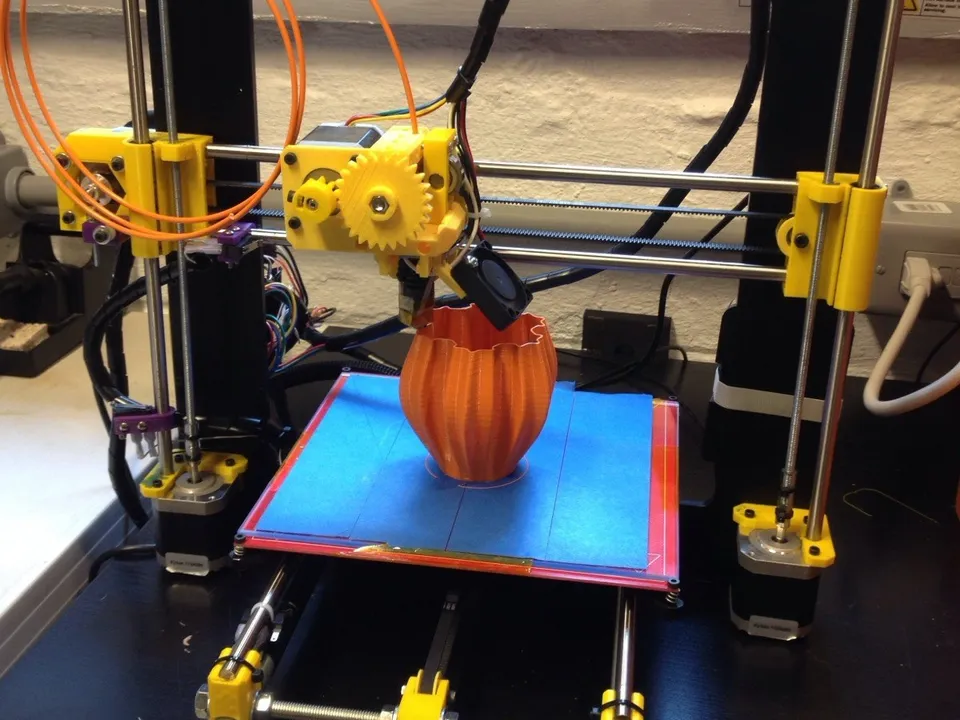
For tall prints, the layouts that keep the part from moving sideways have the mechanical edge: CoreXY, gantry Cartesian and delta. A bedslinger carries the part back and forth on its bed, so a tall, narrow part sways. On height alone, the tallest shipping printers in the database are a 1,000 mm gantry Cartesian, a 550 mm delta, and a CoreXY and a bedslinger at 500 mm each.
Which motion system suits tall prints?
Tall prints suit a layout where the part never moves sideways. On a CoreXY or gantry Cartesian printer it only moves down, or stays put while the gantry rises. On a delta it stays still. A bedslinger moves the part along Y on every move, so tall, narrow parts sway. Parts with a small footprint are most at risk.
What each layout does with the part while it grows:
- Bedslinger: the bed, and the part on it, travels front to back. A SparkLab guide from the University of Northern British Columbia, written for the Bambu Lab A1, explains: “As print height increases, the model’s inertia grows, causing it to sway during the bed’s reciprocating motion.” Its test piece is a cylinder 10 mm across and 220 mm tall.
- CoreXY: the toolhead does all the X and Y travel. Either the bed steps down one layer at a time, or the gantry steps up over a fixed bed, as on the Sovol SV08 Max.
- Gantry Cartesian: the gantry carries the head over a bed that stays put. The Elegoo OrangeStorm Giga works this way.
- Delta: the round bed never moves, and the frame is tall by design. The usable height drops toward the edge of the circle (see the delta printer guide).
Then check the Z figure itself. Among the 56 shipping printers in the database, the tallest of each layout are:
- Gantry Cartesian: the Elegoo OrangeStorm Giga, 800 × 800 × 1000 mm (39.4 in tall), the only printer of its layout in the database.
- Delta: the FLSUN V400 Max, Ø 500 × 550 mm (21.7 in). FLSUN gives 480 mm as the tallest full-width cylinder. Next come the FLSUN S1 Pro at 430 mm in the center (383 mm at the edge) and the FLSUN V2 Max at 390 mm.
- CoreXY: the Sovol SV08 Max, 500 × 500 × 500 mm (19.7 in), then the Creality Ender-5 Max at 400 mm.
- Bedslinger: the Anycubic Kobra 3 Max and Kobra 3 Max V2, both 420 × 420 × 500 mm, then the Snapmaker Artisan at 400 mm.
Only eight shipping printers reach 400 mm of Z: three bedslingers, two CoreXY, two deltas and one gantry Cartesian. Most printers of any layout stop well short of that. The median Z height is 260 mm for the 20 shipping bedslingers, 270 mm for the 31 CoreXY printers and 410 mm for the four deltas.
Why do CoreXY printers handle tall prints better?
A CoreXY never moves the part sideways, and its horizontal moving mass stays the same from the first layer to the last. On a bedslinger the Y axis carries the bed plus every gram already printed, so the load grows with the part. On a CoreXY, Z height sets the limit on a tall part, not the layout.
The growing load matters because of resonance. Klipper’s resonance guide notes that a bedslinger’s resonance frequency falls as filament builds up on the bed. Below about 20 to 25 Hz, it recommends a stiffer printer or less moving mass, since even gentle input shaping then smooths away detail. A CoreXY’s part sits on neither the X nor the Y axis, so its weight never enters that equation.
One published test showed the difference. A Hackaday write-up of an Aurora Tech video comparing the Original Prusa MK4S (bedslinger) with the Prusa CORE One (CoreXY) reports “less ringing and better quality with tall prints” on the CORE One. That compares two printers from one maker, not every CoreXY with every bedslinger. The CoreXY speed guide covers the moving-mass physics.
Does CoreXY print better quality than a bedslinger?
Not by layout alone. Klipper lists the causes of ringing as a frame that is not rigid enough, loose or springy belts, misaligned parts and heavy moving mass. Any layout can suffer from them. Moving mass is the one a bedslinger has more of, and it shows most on tall parts and at high acceleration.
Print quality is not on any spec sheet, so it cannot be read off the motion system. Published comparisons pit one model against another, such as the Prusa pair above. For a printer you are considering, look for a review of that model.
Input shaping, which cancels much of the remaining vibration, is at least as common on bedslingers as on CoreXY printers. In the database, 19 of the 20 shipping bedslingers list it, as do 27 of the 31 shipping CoreXY printers. The input shaping guide explains what it does and does not fix. For footprint, enclosure and access differences, see Cartesian vs CoreXY vs delta.
Which motion system handles large, heavy prints?
Heavy parts suit layouts that keep them off a moving X or Y axis: CoreXY, gantry Cartesian and delta. A bedslinger’s Y motor drives the bed plus the growing part, so the load rises as the print grows. The largest bedslinger in the database adds a second Y motor. A fixed or Z-only bed never slings the weight.
Each layout at the large end of the database:
- Bedslinger: the Anycubic Kobra 3 Max drives its 420 × 420 mm bed with two Y motors. Anycubic markets them as “Dual-Y-axis Motor to Eliminate Layer Misalignment.” Tom’s Hardware’s review called them “unusual and most welcome for large, hefty prints.”
- CoreXY: the Sovol SV08 Max has what Tom’s Hardware describes as “a flying gantry that raises and a fixed bed,” lifted by four Z motors. The large CoreXY printers list has every shipping CoreXY with a bed of 300 mm or more per side.
- Gantry Cartesian: on the OrangeStorm Giga, MakeUseOf’s review says “the bed stays static while the print head moves in all axes.” Its 800 × 800 mm bed is four separate 410 × 410 mm plates.
- Delta: the bed never moves, but the build area is a circle. A box-shaped part 500 mm wide will not fit the V400 Max’s 500 mm circle, because its corners stick out. The delta printers list gives every delta’s diameter and height.
For costume pieces, size the printer from the largest single part first. The helmet and prop sizing guide has the measurements.