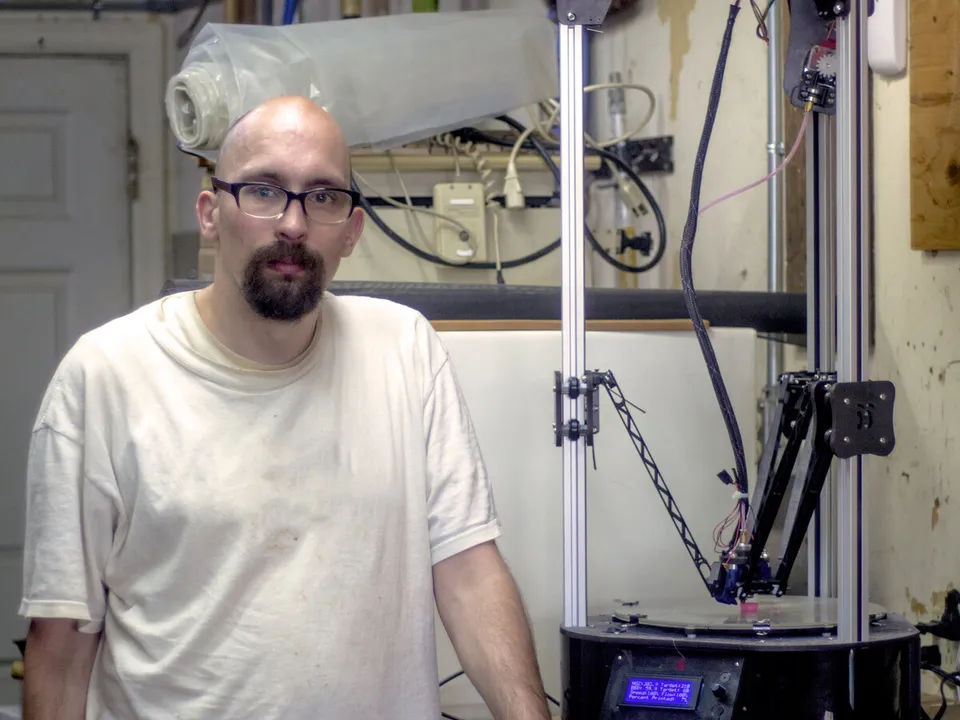
A delta 3D printer hangs its nozzle from three pairs of thin arms, driven by carriages on three vertical towers, over a round bed that never moves. Raising and lowering the three carriages by different amounts puts the nozzle at any point in X, Y and Z.
What is a delta 3D printer?
A delta 3D printer is a filament printer built on the linear delta robot layout. Three vertical towers each carry a sliding carriage. Each carriage holds a pair of parallel arms. The six arms meet at a small platform called the effector, which carries the nozzle. The bed stays still and the nozzle moves above it.
The layout comes from the delta robot, which a team led by Reymond Clavel at the École Polytechnique Fédérale de Lausanne (EPFL) invented in the early 1980s. Its arms are parallelograms, which keep the effector level wherever it moves. The 3D printer version drives the arms with vertical linear actuators, which Wikipedia calls a linear delta design.
The open-source Rostock, a RepRap prototype built in Seattle in 2012, set the pattern. Its design goals list a heated glass print surface “which never moves” and an effector with hotend of “less than 50 grams.” The Kossel, Rostock mini and Rostock MAX are variations of it.
Two things look different on a delta’s spec sheet:
- The build area is a circle. The reachable area is close to a circle between the towers. Klipper, an open-source printer firmware, defines it by a
print_radius that keeps the nozzle from hitting a tower. Specs give a diameter and a height (Ø × H), not three box dimensions.
- The height shrinks toward the edge. The headline height applies at the center of the bed. FLSUN lists the S1 Pro at Ø 320 × 430 mm, but 383 mm tall at the edge. It gives the V400 Max a 550 mm height and 480 mm as the tallest full-width cylinder. If a part is both wide and tall, check it against the lower figure.
How does a delta 3D printer work?
Each tower has its own motor that moves its carriage up or down. The arms have a fixed length, so the nozzle’s position depends on the heights of all three carriages at once. The firmware converts every X, Y and Z move into three carriage heights, and all three motors run together even for a flat, straight line.
That conversion is called inverse kinematics. Klipper’s documentation gives the formula it uses, based on Pythagoras’s theorem. For each tower, carriage height = √(arm length² − (x − tower x)² − (y − tower y)²) + z. Three things follow from it:
- A move straight up raises all three carriages by the same amount.
- A straight sideways line makes each carriage follow its own curve of heights, recalculated continuously along the move.
- The edges are slower. Near the rim, an arm can lie almost flat, and its carriage may then need more acceleration than the nozzle. Klipper caps each motor at three times the printer’s configured acceleration and speed. Moves at “the extreme edge of the build envelope” therefore get lower limits.
Because the motors sit in the frame and only the light effector and arms move, the moving mass is low. The arm length and tower positions must be set accurately in firmware, since every move depends on them. The CoreXY vs bedslinger vs delta guide covers what that means in practice: pros, cons and calibration.
What happened to delta 3D printers?
Delta printers are still sold, but few makers build them. Of the ten brands in this database, only FLSUN sells deltas: four models, out of 81 printers on record. The other nine sell CoreXY, bedslinger, Cartesian or IDEX (independent dual extruder) machines. SeeMeCNC, which sold Rostock MAX delta kits from 2012, built its last RostockMAX v4 in December 2020.
FLSUN went the other way. Its own history says that in 2017 it “discontinued over 90% of our product lines and focused all resources on developing Delta architecture,” and that revenue fell by 80% as a result. Three of its four models in the database launched in late 2024 or 2025:
All four list input shaping, the firmware feature that reduces ringing from vibration. The S1 Pro and T1 Max run Klipper-based firmware. The delta 3D printers list sets their build volumes, speed claims and prices side by side. The motion systems topic compares the delta with the CoreXY and bedslinger layouts the other brands use.