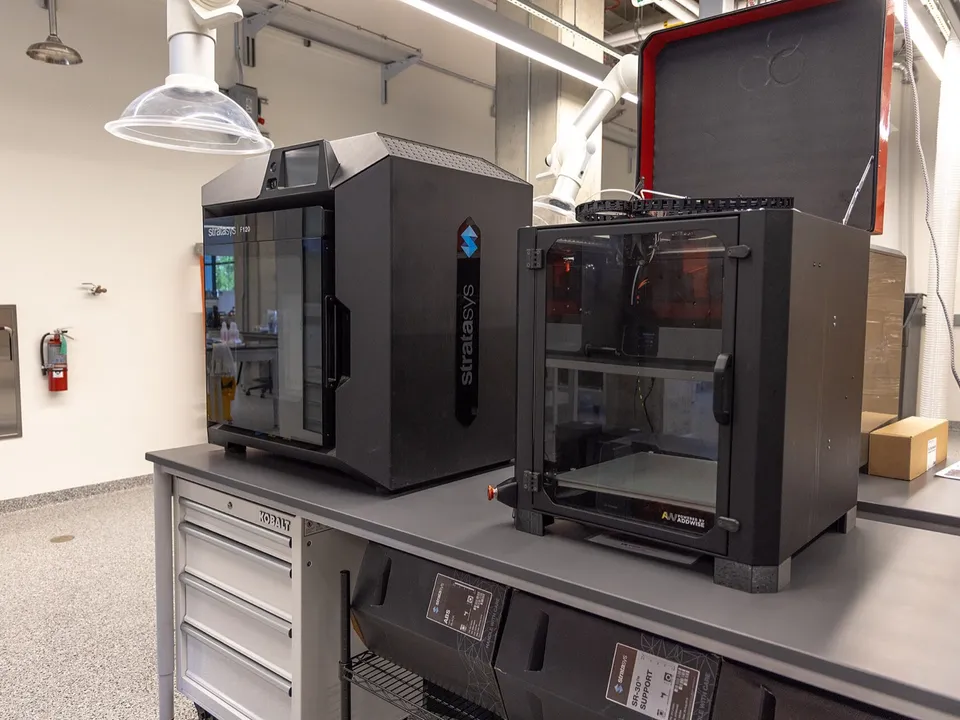
ABS, ASA, polycarbonate (PC) and nylon need an enclosure. PLA, PETG and TPU print on open-frame printers. Bambu Lab, Prusa Research and Polymaker all make filament and agree on this, with two exceptions: PETG in a cold room and some nylons.
| Material |
Enclosure needed? |
What the filament makers say |
| PLA |
No |
Bambu Lab: open-frame or enclosed. Prusa: “not prone to significant warping” |
| PETG |
No, except in a cold room |
Bambu Lab: enclosed recommended against low ambient temperatures |
| TPU |
No |
Prusa: “little to no shrinking or warping” |
| ABS |
Yes |
Prusa: “Requires printer enclosure”. Polymaker: “Mandatory” |
| ASA |
Yes, for large parts |
Prusa: “necessary for printing large parts”. Polymaker: “Required” |
| PC |
Yes |
Prusa: “Consider using an enclosure”. Polymaker: 50 to 60 °C ambient |
| Nylon (PA) |
Yes, for most grades |
Prusa: ventilated room or enclosure “a must”; carbon-fiber nylon can print without one |
What materials need an enclosure?
ABS, ASA, polycarbonate and nylon need an enclosure. So do their carbon-fiber and glass-fiber blends. They shrink as they cool and warp or split in open air, and Bambu Lab says they “require higher heatbed and chamber temperatures to suppress warping and layer separation.” It lists PLA, PETG and TPU as “not prone to warping.”
Fiber-filled grades of any filament also need a hardened steel nozzle, which Bambu Lab marks as required. The hardened nozzle list names the printers that have one as stock.
Can you print ABS on an open printer?
Small ABS parts can print on an open printer, but large ones tend to warp. Prusa Research lists “Requires printer enclosure” among ABS’s drawbacks, Polymaker calls an enclosure “mandatory for temperature stability,” and Bambu Lab marks ABS “Not Recommended” on its open-frame printers. Without an enclosure, Prusa suggests PrusaSlicer’s draft shield.
The draft shield, under PrusaSlicer’s skirt and brim settings, prints a wall around the part that keeps it “slightly warmer.” Prusa’s polycarbonate guide also points to its add-on Original Prusa Enclosure, or a DIY one, for open-frame printers. Prusa recommends a 100 °C bed and a 255 °C nozzle for ABS; Bambu Lab lists 90 to 100 °C and 240 to 280 °C. The ABS and ASA list names the enclosed printers whose bed reaches 100 °C.
Does an enclosure help with PLA?
No. PLA does not need an enclosure, and a hot chamber can soften it inside the extruder and clog it. You can still print PLA in an enclosed printer: Bambu Lab says to open the front door or remove the top glass once the bed is set above 45 °C, because PLA softens below 60 °C.
Bambu Lab adds that a warm room makes this more necessary and a cold one less. Prusa Research says its CORE One printers print PLA “with the enclosure closed due to the active cooling,” and the Prusa CORE One+ (Gen 2) “automatically opens the vent for low-temperature materials (PLA, PETG).”
Do you need an enclosed 3D printer for PETG?
No. Bambu Lab lists PETG for open-frame or enclosed printers, and Prusa Research counts “low warping” among its advantages. The exception is a cold room, where Bambu Lab recommends an enclosed printer so low ambient temperatures do not reduce the part’s interlayer strength. In an enclosed printer, it suggests venting once the bed passes 60 °C.
Do you need an enclosed 3D printer for TPU?
No. Prusa Research says flexible filament shows “little to no shrinking or warping.” Bambu Lab, which sells its own TPU, lists it for open-frame or enclosed printers. Its TPU bed range of 30 to 45 °C stays under the 45 °C point where it says to vent an enclosed printer.
Bambu Lab’s concern with TPU is feeding: it says TPU 95A and softer grades “cannot pass smoothly” through its AMS multi-material feeders. The TPU list names the printers with a direct-drive extruder.
Which enclosure specs matter for ASA?
For ASA, check the enclosure, the bed maximum and the filtration. Prusa Research calls an enclosure “necessary for printing large parts” and suggests a 105 °C bed for the first layer and 110 °C after, with a 260 °C nozzle. Bambu Lab lists a 90 to 100 °C bed and a 240 to 280 °C nozzle.
The ABS and ASA list above uses a 100 °C bed as its cut-off. Prusa also warns that printing “a lot of ASA in an unventilated enclosure can cause the fan shroud and/or extruder plastic parts to deform” over time. The filtration guide covers the filters enclosed printers fit for ABS and ASA fumes.
What do enclosed printers need to print nylon?
Nylon needs a hot nozzle, a hot bed and dry filament. Most grades also need an enclosure, and fiber-filled ones a hardened nozzle. Prusa Research suggests a 285 °C nozzle and a 110 °C bed. Bambu Lab lists 260 to 300 °C for carbon-fiber and glass-fiber nylon, a 100 to 120 °C bed and a 60 °C chamber.
On a spec sheet, check:
- Max hotend temperature: 300 °C covers Bambu Lab’s full range.
- Max bed temperature: 110 °C or more.
- Stock nozzle: hardened, for fiber-filled grades.
Prusa says a warm enclosure “helps a lot” against warping but that carbon-fiber nylon “can be printed without an enclosure.” Polymaker says its own nylons need no enclosure.
Nylon also takes up water: Prusa says badly stored filament can absorb “up to 10% of filament weight,” and Bambu Lab marks drying before use as required. The nylon list names the enclosed printers that ship with a hardened nozzle.
What chamber temperature do ABS, nylon and PC need?
Bambu Lab sets a 60 °C chamber by default for PC and nylon. For ABS and ASA it leaves chamber heating off, and suggests 60 °C only for large, dense or high-strength parts. Polymaker asks for 50 to 60 °C ambient around PC to prevent cracking. Prusa Research gives no chamber figure for any of them.
The settings come from Bambu Studio’s profile for the Bambu Lab X1E, whose chamber heater works between 40 and 60 °C. Bambu Lab leaves ABS and ASA off by default because a heated chamber lengthens warm-up and makes air filtration worse. For printers without a heater, it suggests preheating the bed at its maximum for 15 minutes in a cold room to warm the chamber.
For PC, Prusa suggests a 275 °C nozzle and a 110 °C first-layer bed (115 °C after); Polymaker lists 280 to 310 °C and 110 to 130 °C. The polycarbonate list names the enclosed printers whose hotend reaches 280 °C and bed 110 °C, and the chamber temperature list sorts every enclosed printer by its stated chamber rating.
Will an open-frame printer work in a cold garage?
An open-frame printer can still print PLA and TPU in a cold garage, but low temperatures narrow the rest. Prusa Research says a “Bed thermal runaway” error “typically occurs with ambient temperatures below 18 °C when the printer cannot hold the high heatbed temperature.” Bambu Lab recommends an enclosed printer for PETG when ambient temperatures are low.
ABS, ASA, PC and nylon need an enclosure even in a heated room. Where a printer maker publishes an operating temperature range, check it against the garage’s winter low.