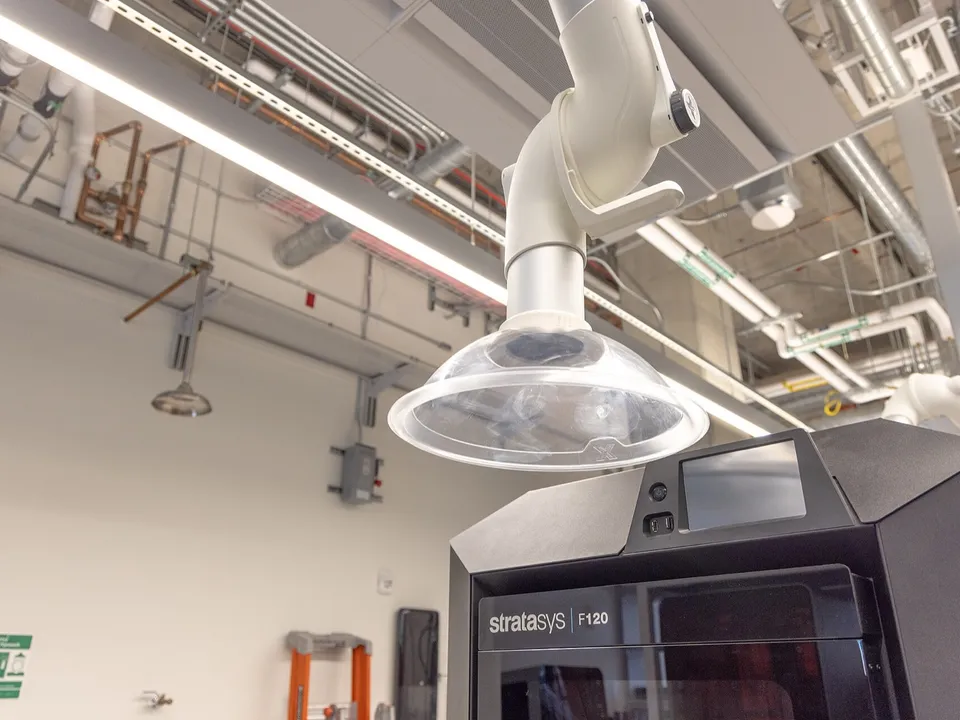
Yes, when the chamber air leaves through a filter. The walls hold particles and gases inside, and the filter decides how much of them reaches the room. Of the 25 shipping enclosed printers in the database, 21 fit a filter as standard, while the 31 shipping open-frame printers fit none.
Do enclosed printers reduce fumes?
Enclosed printers reduce the fumes reaching the room when their chamber air passes through a filter or is vented away. The walls alone hold particles and gases only until the door opens. Research summarized by UL Research Institutes found a ventilated enclosure cut particle concentration by 99.7% and total volatile organic compounds (TVOC) by 69.5%.
An enclosed printer still gives off fumes, because the filament releases them as it melts. Bambu Lab notes that ABS, polycarbonate (PC) and nylon (PA) release more volatile organic compounds (VOCs) than PLA because they print hotter. UL’s Chemical Insights summary puts particle emissions at up to one trillion particles per hour, and says filtration systems “reduce maximum particle concentration by 95% or greater.” These are research findings, not ratings for any one printer.
Smell works the same way: makers fit carbon to cut odor, and the printer still emits. Elegoo says the composite filter for its Centauri Carbon 2 series is “designed to remove ultrafine particles, VOCs, and odors during printing.” Bambu Lab says the VOCs “are absorbed by our activated carbon air filter.”
No filter removes everything. The US Environmental Protection Agency (EPA) notes that “no air cleaner or filter will eliminate all of the air pollutants,” and Prusa Research still tells ABS users to print in a well-ventilated room. Venting the room itself is a separate setup from anything on the printer’s spec sheet.
Which filaments need an enclosure in the first place is covered in materials that need an enclosure.
What is the difference between HEPA and carbon filtration?
HEPA (high-efficiency particulate air) filters trap particles, and activated carbon filters take up gases such as volatile organic compounds (VOCs). The US EPA says a HEPA filter can theoretically remove at least 99.97% of airborne particles 0.3 microns in size. It also notes that most filters handle either particles or gases, so printers fitting both carry two stages.
| Filter |
What it targets |
How makers list it |
| Pre-filter |
A first stage ahead of the HEPA filter |
“G3 Pre-Filter” (QIDI), pre-filter grade G3 (Bambu Lab) |
| HEPA |
Particles, including ultrafine particles |
“H12 HEPA” (QIDI), “HEPA13” (Flashforge) |
| Activated carbon |
Gases: VOCs and odors |
“Coconut Shell Activated Carbon” (QIDI), “Activated Carbon Filter” (Bambu Lab) |
Prusa Research describes its optional Advanced Filtration System the same way: “a HEPA filter for capturing ultra-fine particles (UFP)” and “an activated carbon filter for absorbing chemical vapors (VOC).” One medium does not stand in for the other.
The EPA adds that carbon filters are effective only “provided that there is a large amount of material used in the filter.” The database records whether carbon is fitted, not how much, so a thin pad and a deep bed of granules both show as activated carbon.
What filtration do enclosed printers ship with?
Of the 25 shipping enclosed printers in the database, 17 fit activated carbon as standard. Eleven of those add a HEPA filter, and eight of the 11 also fit a pre-filter. Four list an air filter without naming the media, and four have no filter as standard. No shipping enclosed printer fits HEPA without carbon.
- Activated carbon only (6): Sovol Zero, Anycubic Kobra S1, Anycubic Kobra S1 Max, Bambu Lab P1S, Bambu Lab P2S and Creality K1 Max. Bambu Lab’s P1S spec sheet lists an “Activated Carbon Filter.”
- HEPA and activated carbon (3): Elegoo Centauri Carbon 2, Flashforge Creator 5 Pro (“HEPA13 Filter + Activated Carbon”) and FLSUN S1 Pro. At $399, the Centauri Carbon 2 has the lowest launch price of the 11 with HEPA.
- Pre-filter, HEPA and activated carbon (8): QIDI Q2, QIDI Plus5, QIDI Max4, Bambu Lab X2D, Bambu Lab H2S, Bambu Lab H2D, Bambu Lab H2C and Bambu Lab H2D Pro. QIDI calls its version a “3-in-1 Air Filter”; Bambu Lab’s H2S sheet lists a G3 pre-filter, an H12 HEPA filter and granulated coconut-shell carbon.
- Filter fitted, media not stated (4): Elegoo Centauri Carbon, Creality K2, Creality K2 Pro and Creality K2 Plus. Elegoo describes the Centauri Carbon’s filter as a nano mineral crystal filter that absorbs particles and odors; the database records that as neither carbon nor HEPA. Creality lists one air filter on the K2 and K2 Pro and two on the K2 Plus. It describes them as “for filtering VOCs” without naming the media.
- No filter as standard (4): QIDI Q2C, Prusa CORE One+ (Gen 2), Prusa CORE One L+ and Snapmaker Artisan. QIDI lists the Q2C’s air filter as optional. Prusa offers its Advanced Filtration System, HEPA plus carbon, as an option for the CORE One series.
Optional add-on filters are not counted. The enclosed printers with filtration list sets the 21 printers with a filter side by side, with chamber rating, build volume and launch price.
What should you check about filtration on a spec sheet?
Check which filter media the maker names, whether the filter ships in the box or is sold as an add-on, and how long it lasts before replacement. Spec sheets give media and grades, not measured removal rates, so the named media is the line you can compare across makers.
- The media, by name. Activated carbon for gases and odors, HEPA for particles, a pre-filter ahead of the HEPA stage. A filter listed without its media, as on the Creality K2 series, shows as a dash in the database.
- Standard or optional. QIDI lists the Q2C’s air filter as optional, and Prusa lists HEPA filtration as an “Optional add-on” for the CORE One+ (Gen 2). The database counts only what ships in the box.
- Grades and claims. A HEPA line may carry a grade: H12 on the QIDI Q2 and Bambu Lab H2S, HEPA13 on the Flashforge Creator 5 Pro. Bambu Lab’s H2S sheet rates its VOC filtration as “Superior” and gives no figure. The EPA notes there are “no widely used performance rating systems” for filters that remove gases.
- Replacement. Filters have a working life. Bambu Lab rates the carbon filter for the P1S and X1 series at about 1,440 hours of cumulative printing, and Elegoo sells the Centauri Carbon 2 composite filter in packs of three.
- Chamber heating. Heat and filtration can pull against each other. Bambu Lab’s chamber-temperature guidance, written for the X1E, leaves the chamber heater off by default for ABS and ASA because with it on “the air filtration will get worse.” The heated chamber guide covers chamber ratings.