Bambu Lab printers by motion system: CoreXY or bedslinger

Every Bambu Lab printer in the database, sorted by motion system: the three A-series bedslingers first, then the ten CoreXY models, discontinued ones included.

Published Verified

Part of the topic 3D printer motion systems: every type explained and every printer compared
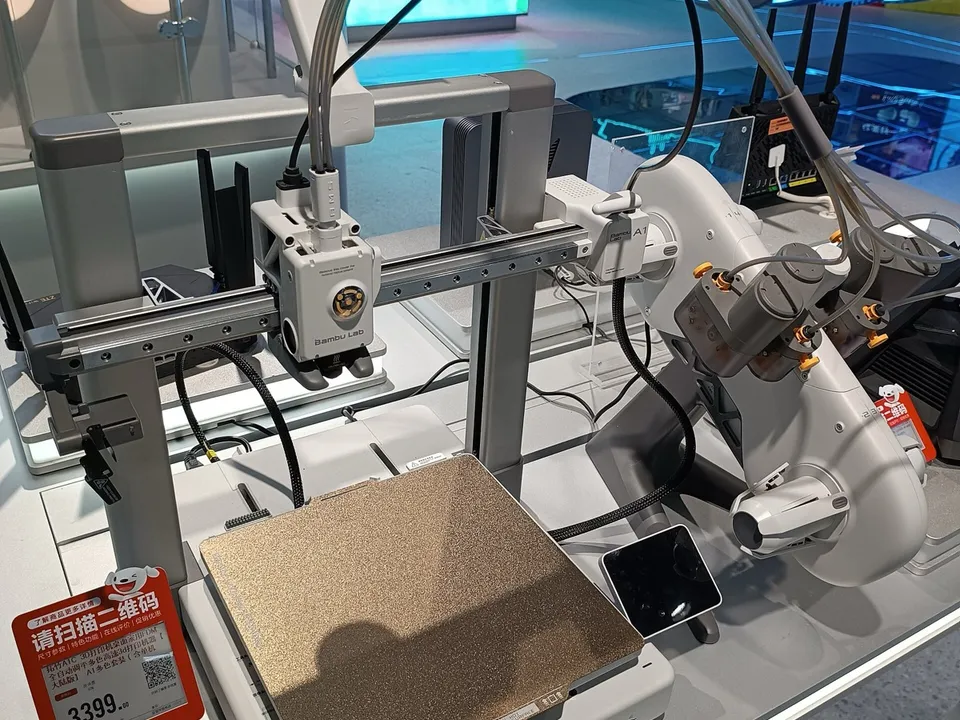
A Bambu Lab A1 on a store display: the toolhead rides an aluminum gantry above a textured build plate that slides front to back, with an AMS lite spool holder beside it.
Photo: NAS 238 WMMNO, CC0 1.0
Bambu Lab printers by motion system: CoreXY or bedslinger
PrinterMotion systemStatusBuild volumeEnclosureMax acceleration (claimed)Launch price
Bambu Lab A2LBedslinger (i3-style)Shipping330 × 320 × 325 mmOpen frame10,000 mm/s²$469
Bambu Lab A1Bedslinger (i3-style)Shipping256 × 256 × 256 mmOpen frame10,000 mm/s²$399
Bambu Lab A1 miniBedslinger (i3-style)Shipping180 × 180 × 180 mmOpen frame10,000 mm/s²$299
Bambu Lab H2D ProCoreXYShipping325 × 320 × 325 mmActively heated chamber20,000 mm/s²$3,799
Bambu Lab X1ECoreXYDiscontinued256 × 256 × 256 mmActively heated chamber20,000 mm/s²$2,499
Bambu Lab X2DCoreXYShipping256 × 256 × 260 mmActively heated chamber20,000 mm/s²$649
Bambu Lab H2CCoreXYShipping305 × 320 × 325 mmActively heated chamber20,000 mm/s²$2,399
Bambu Lab P2SCoreXYShipping256 × 256 × 256 mmEnclosed (passive)20,000 mm/s²$549
Bambu Lab H2SCoreXYShipping340 × 320 × 340 mmActively heated chamber20,000 mm/s²$1,249
Bambu Lab H2DCoreXYShipping325 × 320 × 325 mmActively heated chamber20,000 mm/s²$1,899
Bambu Lab P1SCoreXYShipping256 × 256 × 256 mmEnclosed (passive)20,000 mm/s²$699
Bambu Lab P1PCoreXYDiscontinued256 × 256 × 256 mmOpen frame20,000 mm/s²$699
Bambu Lab X1-CarbonCoreXYDiscontinued256 × 256 × 256 mmEnclosed (passive)20,000 mm/s²$1,199

Bambu Lab’s bedslingers are the A-series: the A1 mini, the A1 and the A2L, whose heated bed slides front to back under the toolhead. Every other Bambu Lab printer in the database is CoreXY, so its bed moves only up and down. The table lists all 13 Bambu Lab records, bedslingers first.

Figures are Bambu Lab’s published specs, and speed and acceleration are its own claims. Discontinued models are included.

Which Bambu Lab printers are bedslingers?

Three Bambu Lab printers in the database are bedslingers: the A1 mini (180 mm cube), the A1 (256 mm cube) and the A2L (330 × 320 × 325 mm). All three are open-frame, still shipping, and claim 10,000 mm/s² acceleration. Bambu Lab uses the term itself and headlines the A1 mini “Bed Slinger, with CoreXY Speed And Quality”.

Bambu Lab’s A2L introduction spells out the layout: the heatbed “is also the Y-axis moving component of the printer,” pulled by its own belt, while a second belt moves the toolhead along X. No Bambu Lab bedslinger ships with an enclosure.

Which Bambu Lab printers are CoreXY?

Ten Bambu Lab printers in the database are CoreXY: the P1P, P1S, P2S, X1-Carbon, X1E, X2D, H2S, H2D, H2D Pro and H2C. The P1P, X1-Carbon and X1E are discontinued. All ten claim 20,000 mm/s² acceleration, and every one except the open-frame P1P is enclosed.

Bambu Lab’s wiki confirms the layout series by series. The X1 page says the X1 “uses a CoreXY motion system controlled by two stepper motors.” So the X1-Carbon is CoreXY, and the X1E product page lists CoreXY too. Bambu Lab ended sales of the P1P on 10 February 2026 and announced the end of the X1 series on 31 March 2026.

The current CoreXY models are the P2S, the X2D and the H2 printers: the H2S, H2D, H2D Pro and H2C. The X2D and H2 models claim 1,000 mm/s and have actively heated chambers rated to 65 °C. The X2D, H2D, H2D Pro and H2C carry two nozzles. The CoreXY explainer shows how two fixed motors steer one toolhead.

Is the Bambu Lab P1S CoreXY?

Yes. The Bambu Lab P1S is a CoreXY printer: two stepper motors pull two belts to move the toolhead in X and Y, and the bed moves only in Z. Bambu Lab’s P1 series wiki describes the CoreXY motion system and states that the “P1P and P1S share the same motion system.” It is not a bed slinger.

The P1S has the same 256 × 256 × 256 mm build volume as the A1 and claims 20,000 mm/s² acceleration to the A1’s 10,000. It shares its motion system and speed claims with the X1-Carbon too. The two differ on bed temperature, nozzle and sensors, set out in the P1S vs X1-Carbon comparison.

Is the Bambu Lab P2S a bed slinger?

No. The Bambu Lab P2S, released in October 2025, is CoreXY. Bambu Lab’s P2S introduction says it “is built on a Core-XY architecture,” with two stepper motors each driving a belt to the toolhead. Its Y axis moves the toolhead and X gantry together on rods at both sides of the frame, so the bed never slides.

What changes between a Bambu Lab bedslinger and a CoreXY model?

Within Bambu Lab’s range, the layout shows up in three spec lines. The bedslingers are open-frame and claim 10,000 mm/s² acceleration. The CoreXY models claim 20,000 mm/s², and nine of the ten are enclosed. Footprint differs too: the A1 needs extra depth for its bed to travel, while the P1S bed moves only in Z at the same build volume.

Footprint. Bambu Lab lists the A1 at 465 × 410 × 430 mm (18.3 × 16.1 × 16.9 in) and the P1S at 389 × 389 × 458 mm (15.3 × 15.3 × 18.0 in), both with a 256 mm cube build volume. For the A1, Bambu Lab’s FAQ asks for about 695 mm (27.4 in) of depth (410 + 90 + 195 mm) so the heatbed can travel front and back.

Enclosure. The A1 FAQ advises against enclosing the A1. The A2L wiki advises against enclosed printing of high-temperature materials: a built-in ambient temperature sensor raises an alert when the air gets too warm. The A1 mini FAQ lists ABS, ASA, polycarbonate (PC), nylon (PA) and PET as not recommended. Bambu Lab sells the P1S as a “Fully Enclosed Design” for engineering-grade filaments. The X1E, X2D and H2 models add an actively heated chamber.

Speed. Top-speed claims overlap: the A-series, P1P, P1S and X1 models all claim 500 mm/s. The gap is in acceleration, at 10,000 against 20,000 mm/s². The motion systems guide covers the layouts across all makers, and the Bambu Lab brand page lists each model with its full record.

Sources

Last verified

  1. Bambu Lab EU Store, Bambu Lab A1 mini ("Bed Slinger, with CoreXY Speed And Quality"; FAQ on materials) (accessed Oct 14, 2026)
  2. Bambu Lab EU Store, Bambu Lab A1 (physical dimensions; FAQ: "Is it OK to enclose the A1?") (accessed Oct 14, 2026)
  3. Bambu Lab Wiki, A1 FAQ (space to reserve for heatbed movement) (accessed Oct 14, 2026)
  4. Bambu Lab Wiki, A2L Introduction (Cartesian motion system, heatbed is the Y-axis moving component) (accessed Oct 14, 2026)
  5. Bambu Lab Wiki, A2L FAQs (enclosed use) (accessed Oct 14, 2026)
  6. Bambu Lab Wiki, Introduction to P1 series (CoreXY motion system, P1P and P1S share the same motion system) (accessed Oct 14, 2026)
  7. Bambu Lab EU Store, Bambu Lab P1S (physical dimensions, enclosed design) (accessed Oct 14, 2026)
  8. Bambu Lab Wiki, P2S Introduction (Core-XY architecture) (accessed Oct 14, 2026)
  9. Bambu Lab Wiki, Introduction to X1/X1C (CoreXY motion system) (accessed Oct 14, 2026)
  10. Bambu Lab Wiki, X2D Introduction (Core-XY system) (accessed Oct 14, 2026)
  11. Bambu Lab Wiki, H2D Belt Tensioning Procedure (CoreXY motion system) (accessed Oct 14, 2026)
  12. Bambu Lab, X1E product page (CoreXY, 60 °C active chamber heating) (accessed Sep 29, 2026)
  13. Bambu Lab, A1 technical specifications (accessed Sep 29, 2026)
  14. Bambu Lab, A1 mini technical specifications (accessed Sep 29, 2026)
  15. Bambu Lab, A2L spec sheet PDF (500 mm/s, 10 m/s²) (accessed Sep 29, 2026)
  16. Bambu Lab, P1 series product page (CoreXY, 500 mm/s, 20000 mm/s² acceleration) (accessed Sep 29, 2026)
  17. Bambu Lab, P2S technical specifications (accessed Sep 29, 2026)
  18. Bambu Lab, X2D technical specifications (accessed Sep 29, 2026)
  19. Bambu Lab, H2D technical specifications (accessed Sep 29, 2026)
  20. Bambu Lab Blog, A farewell to P1P (2026-02-10) (accessed Sep 29, 2026)
  21. Bambu Lab Blog, The X1-series is EOL (2026-03-31) (accessed Sep 29, 2026)