A 3D laser printer is one of three machines: a resin printer that cures liquid resin with a laser, a powder printer that fuses plastic or metal powder with a laser, or a filament printer fitted with a laser engraving module. The ordinary desktop filament printer melts plastic in a heated nozzle and uses no laser to print.
What is a 3D laser printer?
A 3D laser printer is any 3D printer that builds or works on parts with a laser. Three kinds share the name: laser stereolithography (SLA) printers that cure resin, selective laser sintering (SLS) printers that fuse powder, and fused deposition modeling (FDM) filament printers with a laser module that engraves or cuts.
Metal powder printers go by selective laser melting (SLM) or direct metal laser sintering (DMLS). The international standard for 3D printing terms, ISO/ASTM 52900, sorts printing processes into seven categories, and each kind maps to one of them:
| What people call it |
ISO/ASTM 52900 category |
What the laser does |
Typical material |
| Laser SLA |
Vat photopolymerization |
Cures liquid resin into solid plastic |
Photopolymer resin |
| SLS |
Powder bed fusion |
Fuses polymer powder |
Nylon 12, nylon 11, TPU |
| SLM, DMLS |
Powder bed fusion |
Melts or sinters metal powder |
Stainless steel, aluminum, titanium alloy |
| FDM with a laser module |
Material extrusion (the printing side) |
Engraves or cuts a separate workpiece, not the print |
Wood, leather, dark acrylic |
The third kind is a filament printer first. It prints by extrusion and adds a diode laser for engraving and cutting. The 3D printer laser combos hub covers these machines, and the list of 3D printers with a laser engraver sets their specs side by side.
This site’s database covers desktop FDM printers only. Laser SLA, SLS and metal powder bed fusion machines are not listed here, so check their makers’ spec sheets.
Do 3D printers use lasers?
Some do, but desktop filament (FDM) printers do not: they melt plastic in a heated nozzle. Many resin printers, including the Formlabs Form 4, cure resin with LEDs shining through an LCD mask instead. Lasers do the printing in laser SLA resin printers and in selective laser sintering (SLS) and metal powder bed fusion printers.
Where each common type gets its energy:
- Filament (FDM, material extrusion): a heated nozzle. Filament is pushed through it, melts and is laid down layer by layer. The Bambu Lab H2S spec sheet lists its printing technology as fused deposition modeling and its maximum nozzle temperature as 350 °C.
- LCD or masked stereolithography (MSLA) resin: LEDs and an LCD screen that masks each layer. Formlabs moved its resin line from a laser on the Form 3+ to a 60-LED backlight and an LCD on the Form 4.
- Digital light processing (DLP) resin: a digital light projector.
- Laser SLA resin: a laser steered by galvanometer mirrors, as on the Formlabs Form 3+.
- SLS and metal powder bed fusion: a fiber laser. The Formlabs Fuse 1+ 30W sinters nylon powder with a 30 W ytterbium fiber laser. The metal machines at the US National Institute of Standards and Technology (NIST) use 200 W and 400 W ytterbium fiber lasers.
Some FDM printers also carry a laser as a sensor. The Bambu Lab X1-Carbon has a Micro Lidar, sold as a spare part named “Dual Red Laser”. It measures test lines to calibrate flow and inspects the first layer. The laser module on the Bambu Lab H2S adds an 850 nm infrared laser for height measuring beside its 455 nm engraving laser. Neither prints anything.
Not every powder bed fusion printer uses a laser either. Loughborough University’s summary of the category lists electron beam melting and selective heat sintering beside the laser methods.
How does a 3D laser printer work?
A 3D laser printer moves a focused laser over a thin layer of material, one cross-section at a time. In laser SLA it hardens liquid resin, and in SLS or SLM it fuses powder. On an FDM laser combo, the printer’s motion system carries the laser over a flat workpiece to engrave or cut it.
Laser SLA (resin)
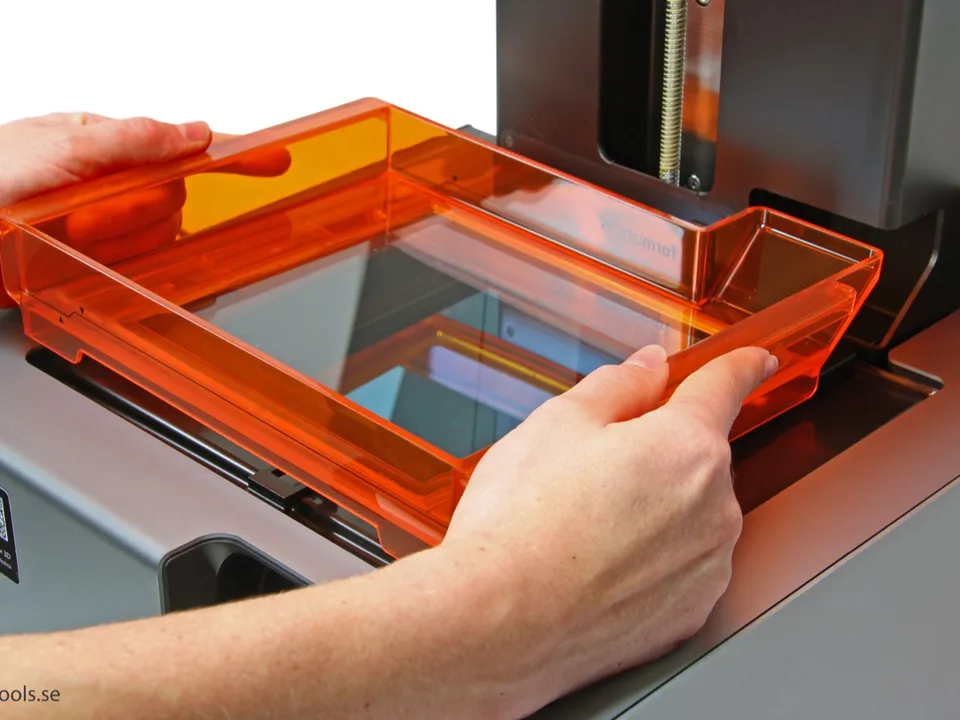
- The build platform dips into a tank of liquid resin. In the inverted layout Formlabs uses, the laser sits under the tank and the part hangs upside down from the platform.
- Galvanometer mirrors steer the laser across the bottom layer of resin, tracing the part’s cross-section. The resin hardens wherever the light lands.
- The platform lifts by one layer, fresh resin flows in, and the laser traces the next cross-section.
- The finished part is washed in alcohol to remove liquid resin. Many resins then need a post-cure under light.
- The printer heats the powder to just below its melting point.
- A recoater spreads a thin layer of powder across the build platform.
- The laser scans the cross-section and fuses the particles into solid material.
- The platform drops by one layer, typically 50 to 200 microns, and the cycle repeats. The unfused powder holds the part up, so it needs no support structures.
- After cooling, the parts are dug out and cleaned. The loose powder can be recycled.
SLS runs on polymer powders such as nylon. SLM and DMLS run the same cycle on metal powder.
FDM printer with a laser module
- The laser module is fitted to the printer. On the Bambu Lab H2S it comes in the Laser Edition or as a Laser Upgrade Kit.
- A workpiece, such as basswood plywood or leather, goes on the bed. The Bambu Lab H2S finds it with a camera and measures its height with the module’s infrared laser.
- The printer’s X and Y motion carries the module while its 10 W, 455 nm diode laser burns an image into the surface or cuts through it. Bambu Lab rates that module to cut 5 mm basswood plywood.
- Laser safety windows contain the beam, and door and flame sensors watch the job. Bambu Lab rates the bare module Class 4 and the complete, closed printer Class 1.
Printing and engraving are separate jobs on the same machine. The 3-in-1 3D printer guide explains the multi-tool format. Before fitting a module, read the desktop laser safety guide on what Class 1 and Class 4 mean.
Which desktop 3D printers have a laser?
The desktop printers in this database that take a laser are FDM machines with a laser module, such as the Bambu Lab H2D, H2S, H2C and H2D Pro and the Snapmaker Artisan. Each prints with a heated nozzle and engraves or cuts with a separate diode laser. Laser SLA and SLS printers are not in the database.
- Bambu Lab H2D: 10 W or 40 W module, sold in the Laser Full Combo or as an upgrade kit.
- Bambu Lab H2S: 10 W module only.
- Bambu Lab H2C: 10 W or 40 W module, in the H2C Laser Full Combo or as an upgrade kit.
- Bambu Lab H2D Pro: 10 W or 40 W module through the Laser Upgrade Kit.
- Snapmaker Artisan: ships with a 10 W module, or a 40 W module in the Artisan Premium, plus a CNC module.
The list of 3D printers with a laser engraver holds the full, current set with print specs. The 10 W vs 40 W laser module guide explains what the extra power changes.

.jpg)