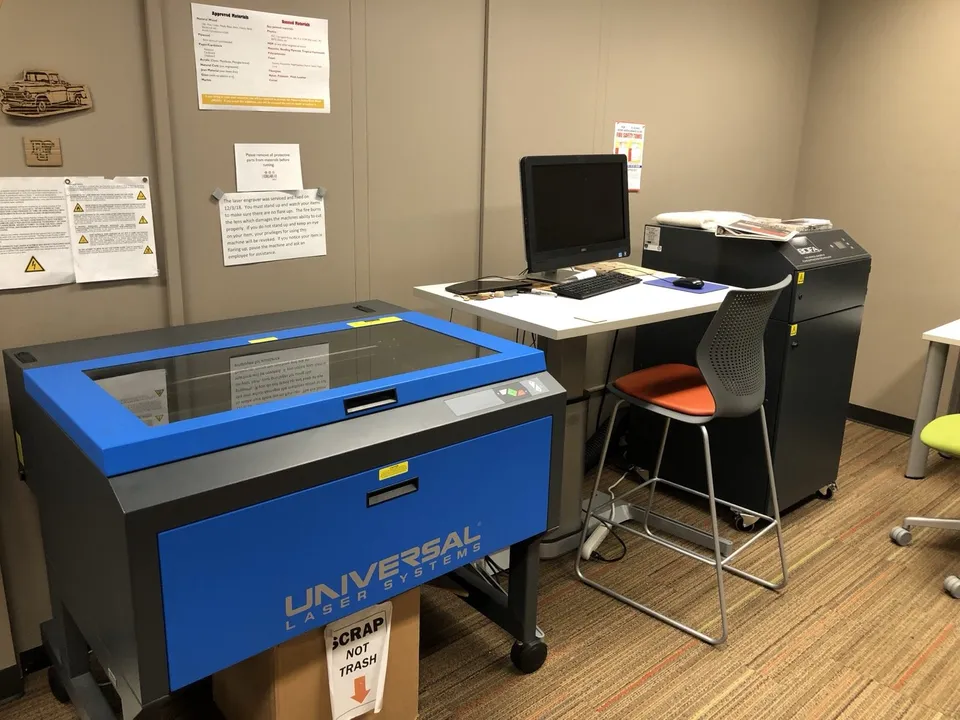
Laser engraving smoke is a mix of fine particles and harmful gases, and it must be ducted outdoors or pulled through a purifier with high-efficiency particulate air (HEPA) and activated carbon stages. Wood and MDF give off soot, benzene, formaldehyde and acrolein. Acrylic releases methyl methacrylate, and PVC and some other plastics release corrosive or toxic gases.
Are laser engraving fumes dangerous?
Yes. Laser smoke carries fine particles and gases, and the mix depends on the material. Carnegie Mellon University’s laser cutter guideline lists soot, benzene, formaldehyde, acrolein and polyaromatic hydrocarbons (PAHs) from wood, MDF and plywood, and methyl methacrylate (MMA) from acrylic. The Occupational Safety and Health Administration (OSHA) calls for ventilation that keeps such fumes below exposure limits.
What common engraving materials release, from the Carnegie Mellon and University of Florida safety offices:
| Material |
What the smoke contains |
| Wood, plywood, MDF |
Soot, benzene, formaldehyde, acrolein, PAHs. The adhesives in plywood and MDF can give off formaldehyde. |
| Acrylic (PMMA) |
MMA and ethyl acrylate, acetone, formaldehyde, phenol, PAHs |
| Acetal (POM, Delrin) |
Formaldehyde |
| Leather |
Natural leather is on the University of Florida’s acceptable list. Synthetic leather is acceptable only if it contains none of the banned materials below. |
Emissions continue after the laser stops. A 2023 study in the Journal of Chemical Health & Safety measured a CO2 laser cutter cutting acrylic. MMA in the room averaged 0.5 parts per million (ppm), below OSHA’s 100 ppm permissible exposure limit.
The particles were the bigger finding. Nanoplastic particles of 15.4 to 86 nm escaped each time the lid opened, and particle levels kept rising for at least 20 minutes after a cut. The authors suggest leaving the exhaust on for a few minutes after the job ends.
Which materials should you never laser cut?
Never laser cut PVC, vinyl or other chlorine-containing materials, PTFE (Teflon), ABS, polycarbonate, polystyrene foam, fiberglass, coated carbon fiber, or any plastic you cannot identify. University safety offices ban them because they release toxic or corrosive gases such as hydrogen chloride and hydrogen cyanide, damage the machine, or catch fire easily.
| Material |
Why it is banned |
| PVC, vinyl, neoprene |
Halogen-containing. PVC gives off hydrogen chloride (HCl), possibly phosgene, benzene and trace dioxins. The chlorine also corrodes the optics and machine parts. |
| PTFE (Teflon) |
Fluorocarbons and hydrogen fluoride (HF) |
| ABS |
Hydrogen cyanide and styrene. It melts, ignites easily and leaves deposits on the grid. |
| Nylon, polyurethane, some rubbery acrylics |
Hydrogen cyanide, from their carbon-nitrogen bonds |
| Polycarbonate (Lexan) |
Benzene, toluene, xylene, cresol and PAHs. It discolors and ignites instead of cutting cleanly. |
| Polystyrene and polypropylene foam |
The University of Illinois calls foam “a top cause of laser cutter fires” |
| Fiberglass, coated carbon fiber |
Fiberglass gives off fumes, and coated carbon fiber gives off noxious fumes |
| Unidentified plastics |
Unknown emissions. The University of Florida says never to cut a material whose composition you are unsure of. |
Bambu Lab’s laser safety document says the same about its H2 series modules: do not engrave or cut materials that “could release harmful gases, such as PVC,” or materials you do not know. It lists the supported types as wood, rubber, metal sheet, leather, dark acrylic and stone. Before cutting an unfamiliar sheet, read its safety data sheet (SDS). For acrylics, the University of Florida points to the “stability and reactivity” section.
Do you need to vent a desktop laser cutter outside?
No. Venting outside is one of two accepted routes. Bambu Lab’s laser safety document says all exhaust must be “either filtered through an air purifier or discharged outdoors where it can safely dissipate.” Either way, a duct carries the smoke out a window or into a purifier built for laser smoke, never straight into the room.
What the hybrid machine makers supply:
- Bambu Lab H2D, H2S and H2C: the Laser Upgrade Kit includes a smoke ventilation pipe and a pipe adapter with a 100 mm outer diameter. Bambu Lab’s instructions say to use that pipe to vent outside, or to buy its Smoke Purifier.
- Snapmaker Artisan: the enclosure has its own exhaust fan. The standard Artisan’s fan moves up to 36 cubic feet per minute (CFM), which Snapmaker says is enough for the 10 W laser module. The Artisan Premium ships with the Boosted Exhaust Fan, rated at 95 CFM, which Snapmaker describes as “particularly beneficial” with the 20 W and 40 W modules. The 10 W vs 40 W laser module guide covers the power difference.
How to vent laser smoke from a desktop machine
- Fit the maker’s adapter to the machine’s exhaust port and clamp the duct to it. Bambu Lab says to pull on the pipe after assembly to confirm it does not detach.
- Run the duct to a window and fix it in place. Bambu Lab warns that the pipe must be secured so it cannot fall in bad weather.
- Point the outlet away from people. The University of Illinois says ventilated air “should not be routed to public or occupied areas,” and Bambu Lab says to confirm that venting outdoors complies with local rules.
- Turn the ventilation on before the job starts, as Carnegie Mellon’s guideline requires, and leave it running a few minutes after the job ends.
- If smoke leaks or you smell it in the room, stop the job and check the duct. Bambu Lab gives the same instruction.
Eye protection, interlocks and fire risk are covered in the desktop laser safety guide.
What smoke purifier do you need for desktop laser cutting?
You need a duct-connected purifier built for laser smoke. It should have particle stages (a coarse pre-filter, a medium filter and a HEPA filter) and a dense activated carbon stage for the gases. It must fit your machine’s exhaust duct. A household air purifier is a different device: Snapmaker notes it filters a whole space, not the machine’s exhaust.
What to check before you buy one:
- Both kinds of filter media. The US Environmental Protection Agency (EPA) notes that “most filters are designed to filter either particles or gases.” HEPA catches the particles. Activated carbon takes up the gases, and the EPA adds that carbon needs “a large amount of material used in the filter” to work.
- Duct fit. Bambu Lab’s H2 ventilation adapter has a 100 mm outer diameter. Snapmaker’s purifier has a 70 mm air inlet and a 75 mm by 2,000 mm hose, and Snapmaker says it must be used with the Snapmaker enclosure.
- Airflow. Snapmaker rates its purifier at 150 m³/h. Bambu Lab does not list an airflow figure for its Smoke Purifier on the store page.
- Filter life and refills. Bambu Lab recommends replacing the primary filter every 80 to 100 hours, the medium filter every 300 to 500 hours and the high-efficiency filter every 800 to 1,000 hours. Snapmaker quotes about 3 months for its cartridge under typical laser use.
- Air assist is not extraction. Snapmaker’s FAQ says air assist improves engraving quality and keeps the machine clean, while the purifier protects you from breathing in the smoke.
What Bambu Lab and Snapmaker list for their machines
- Bambu Lab Smoke Purifier (H2 laser editions): a G4 primary filter, an F8 medium filter, a carbon filter rated at 1,200 mg/g adsorption and an H13 HEPA filter. It beeps when a filter reaches the end of its life. The box includes a 2 m smoke ventilation pipe that can also run outside a window.
- Snapmaker Air Purifier (Snapmaker 2.0, Artisan and Ray): one cartridge with a G4 filter, an F9 filter, an activated carbon layer and two 70 mm-thick H13 HEPA layers. Snapmaker lists 95.9% filtration efficiency for 0.3 to 0.5 μm particles and a maximum noise of 65 dB with the hose fitted. Remaining filter life shows on the machine’s touchscreen.
Does a 3D printer’s built-in air filter handle laser smoke?
Not according to either maker. The Bambu Lab H2D, H2S and H2C fit a pre-filter, HEPA and carbon filter for printing. Bambu’s laser instructions name only the ventilation pipe or the separate Smoke Purifier for laser smoke, and its H2D page offers an “optional air purifier” for “indoor laser operations.” The Snapmaker Artisan has no built-in filter at all.
Bambu Lab describes the H2 series air filter as filtering “the air inside the chamber, effectively removing VOCs” (volatile organic compounds), with replacement after 1,440 hours (or 60 days) of printing. That is a printing figure. It says nothing about laser smoke.
Every machine with a laser option is in the 3D printers with laser engraver list.