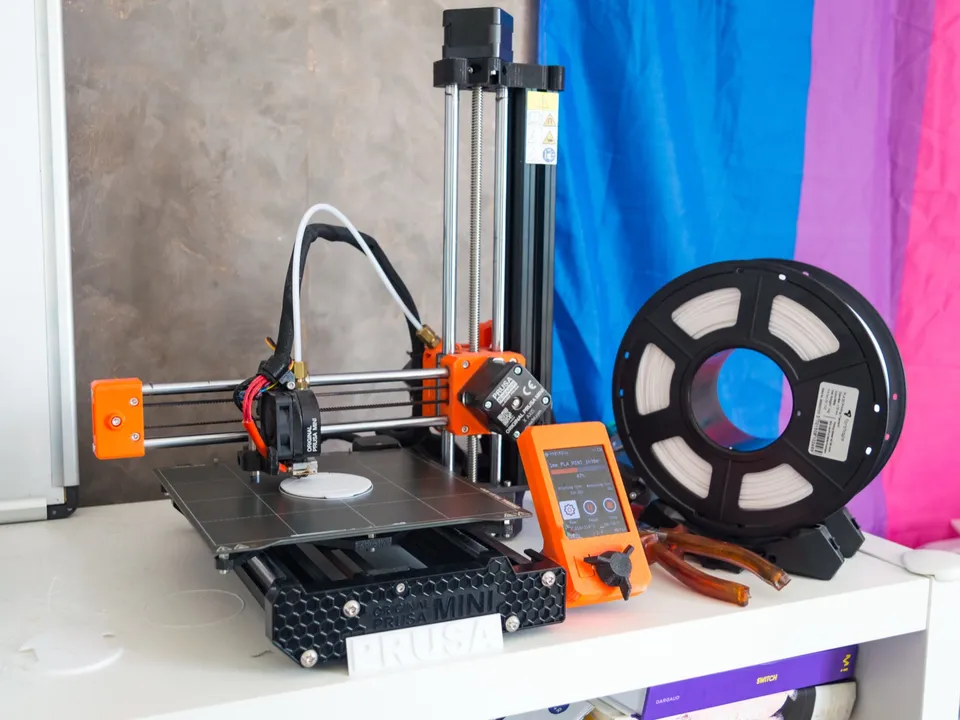
A cantilever 3D printer holds its toolhead arm from one side only, on a single vertical column, while the bed slides front to back underneath. Its main limitation is size. An arm fixed at one end flexes more the longer it gets, so these printers stay small: the Bambu Lab A1 mini and the Prusa MINI+ both print 180 × 180 × 180 mm (7.1 in per side).
What is a cantilever 3D printer?
A cantilever 3D printer is a Cartesian printer whose X arm is fixed to one vertical Z column and hangs free at the other end. The arm rides up the column for Z, the toolhead runs along the arm for X, and the bed moves front to back for Y. A standard gantry is held at both ends instead.
TechRadar’s review of the Original Prusa MINI describes “a simple one-arm construction”: “A single tube extrusion raises vertically for the Z-axis, and the X print head then moves along the X-axis arm.” 3DPros puts it the same way: “there is only one Z upright supporting the extruder arm.”
Several printers of similar shape hold their gantry at both ends. Tom’s Hardware reports “dual Z rods” on the Bambu Lab A1 and the Bambu Lab A2L, and dual lead screws inside the gantry of the Creality SPARKX i7. The Creality Hi has a one-piece gantry whose two legs fit into the base.
Is a cantilever printer a bed slinger?
Yes. A cantilever printer moves its toolhead only in X and Z, so the bed carries the Y axis and slides front to back under the part. That is the defining trait of a bedslinger. 3DPros calls cantilever printers “cartesian XZ-head printers,” and Bambu Lab’s own product page for the A1 mini calls it a bed slinger.
This database files cantilever printers under bedslinger kinematics, not as a type of their own. The A1 mini is listed as a bedslinger and appears wherever bedslingers are filtered, as on the fastest bedslinger printers list. Every trait of a moving bed applies, including the effect on tall parts covered in the motion systems guide.
What are the limitations of a cantilever printer?
The main limitation is build size. An arm held at one end bends more as it gets longer, so makers keep the arm short and the bed small. The A1 mini and the Prusa MINI+ both print 180 × 180 × 180 mm. The arm also needs bearings with almost no play, and the bed still moves under the part.
- Arm length caps the build volume. 3DPros explains that one-sided support limits the arm’s length because “any arm flex gets amplified the longer the arm is,” which “limits bed size, so cantilever printers are small.” For a beam fixed at one end and loaded at the other, Wikipedia’s deflection article notes that “if the span doubles, the deflection increases eightfold.” Bambu Lab’s two-sided A1 prints a 256 mm (10.1 in) cube, against 180 mm on the A1 mini.
- No room for play at the free end. 3DPros notes that the extruder arm “cannot have any free play, which would cause print quality issues when the extruder is near the end of the arm.” That puts the weight on the bearings the toolhead runs on; the rails, rods and wheels guide compares the options.
- The bed still moves. The part travels with the bed on every Y move, as on any bedslinger. Tall, narrow prints feel that most. The tall prints guide covers which layouts keep the part still.
The design does save hardware: 3DPros notes cantilever printers are “less expensive because they require less hardware, and they have a smaller footprint.”
Which printers use a cantilever design?
Desktop cantilever printers include the Bambu Lab A1 mini and the Original Prusa MINI+, both with a 180 × 180 × 180 mm build volume. 3DPros also names the Creality Ender 2 Pro, the Kingroon KP3S, the Tronxy X1 and the Tronxy CRUX1. Of these, only the A1 mini has a record in this database.
Tom’s Hardware describes the A1 mini as “a cantilever designed 3D printer.” Its record lists 180 × 180 × 180 mm, a 500 mm/s top speed and 10,000 mm/s² acceleration, all manufacturer figures. Prusa Research released the original MINI in October 2019 and replaced it with the MINI+ in November 2020, according to 3DPros.
What should you check before buying a cantilever printer?
Check the build volume against your largest part, the desk depth the moving bed needs, and the maker’s speed and acceleration figures. The A1 mini lists 180 mm on every axis, measures 315 mm deep but needs about 390 mm with its bed in motion, and claims 500 mm/s and 10,000 mm/s².
- Build volume, axis by axis. A part longer than 180 mm in X or Y, or taller than 180 mm, will not fit an A1 mini or a MINI+ in one piece. Measure your largest planned part first. The build volume guide covers sizing.
- Desk depth. Bambu Lab lists the A1 mini at 347 × 315 × 365 mm (13.7 × 12.4 × 14.4 in), and its wiki asks for about 390 mm (15.4 in) of depth for the moving bed.
- Speed and acceleration claims. These are manufacturer figures, not test results. The A1 mini and the larger A1 list the same 500 mm/s and 10,000 mm/s². Bambu Lab says the A1 mini runs automatic resonance calibration on X and Y, a form of input shaping. The speed claims guide explains what these figures leave out.
Every record in the printer database uses the same spec sheet, so a cantilever printer’s figures line up field for field with two-sided gantry models of similar size.