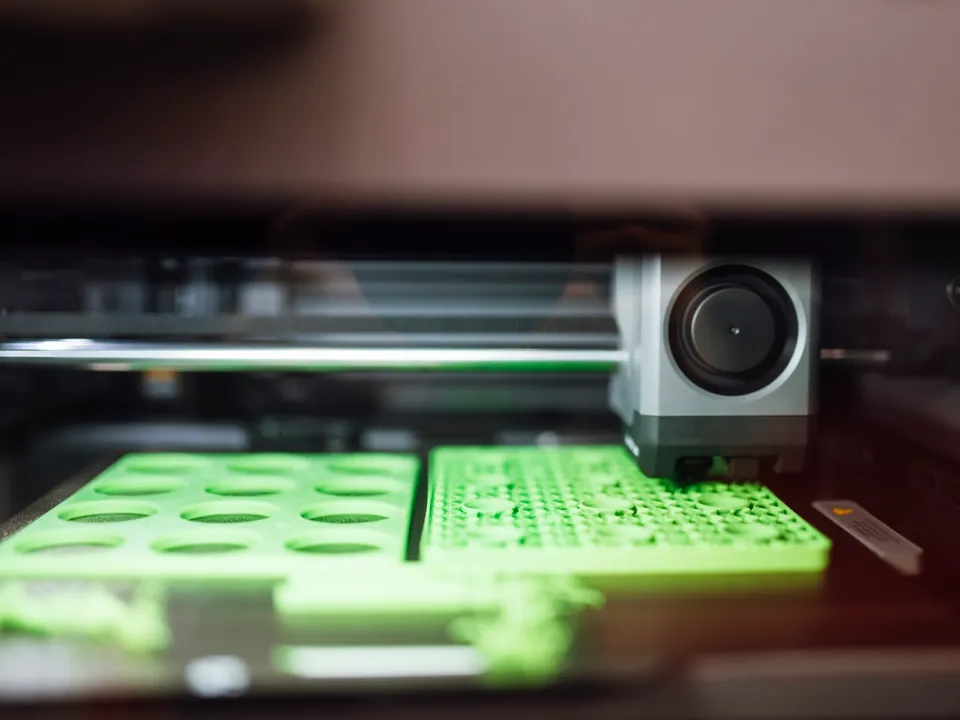
A 300 × 300 mm bed has 37% more area than a 256 × 256 mm bed (44% more than a 250 mm bed), and a 350 × 350 mm bed has 87% more. As cubes, 256, 300 and 350 mm hold 16.8, 27.0 and 42.9 liters, so a 350 mm cube holds about 2.6 times a 256 mm cube.
| Bed side |
Bed area |
Area vs 256 mm bed |
Cube volume |
50 mm parts per plate |
| 250 mm (9.8 in) |
62,500 mm² |
5% less |
15.6 L |
16 |
| 256 mm (10.1 in) |
65,536 mm² |
baseline |
16.8 L |
16 |
| 300 mm (11.8 in) |
90,000 mm² |
37% more |
27.0 L |
25 |
| 350 mm (13.8 in) |
122,500 mm² |
87% more |
42.9 L |
36 |
The last column is a grid of 50 mm square parts with 10 mm gaps. Miniatures and small functional parts fit any of these beds, so for them the extra area buys more parts per plate.
Shipping printers in each class, from the database:
How big is a 256 mm build volume in real terms?
A 256 mm cube measures 10.1 inches on each side and holds 16.8 liters. A size 7 basketball, 750 to 770 mm around under FIBA rules (239 to 245 mm across), fits inside with a few millimeters to spare. A US Letter sheet, 216 × 279 mm, cannot lie flat on a 256 mm bed, even turned diagonally.
A 10-inch record, 250.8 mm across in the RIAA standard, lies flat on a 256 mm bed. A 12-inch record, at 301.6 mm, does not.
What fits on a 300 x 300 mm print bed?
A 300 × 300 mm bed takes flat parts up to 300 mm on a side. A US Letter sheet lies flat on it with 21 mm to spare, and an A4 sheet (210 × 297 mm) with 3 mm. A 256 mm bed holds neither. Batches of 50 mm parts grow from 16 to 25 per plate.
A 12-inch record, 301.6 mm across, still overhangs a 300 mm bed by about 2 mm. A 350 mm bed fits one.
Whether a full-size helmet fits depends on the model and your head size, so measure the file before you size the printer. The helmets and props guide has the numbers.
What are common 3D printer sizes in inches?
Desktop printer beds commonly measure 7.1 to 19.7 inches on a side: 180 mm is 7.1 in, 220 mm is 8.7 in, 256 mm is 10.1 in, 300 mm is 11.8 in and 350 mm is 13.8 in. Larger machines reach 400 mm (15.7 in) and 500 mm (19.7 in). To convert, divide millimeters by 25.4.
The standard bed size guide counts how many printers use each size.
Does bed size or Z height matter more?
Bed size matters more for most parts. It sets the widest flat part and how many parts fit on one plate. Z height, the print height, matters only for tall parts such as vases, lamps and standing figures. On 42 of the 56 shipping printers in the database, height is within 10% of the longer bed side.
The exceptions, from the records:
Bed size also shows up in heat-up time at the far end of the database. Elegoo quotes 17 minutes for the 800 × 800 mm platform of the Elegoo OrangeStorm Giga to reach 100 °C at 25 °C room temperature, and the printer can heat just the plate under a model. For every printer with a bed of 300 mm or more, see the large-format list. To size a printer from your own parts, read what size 3D printer you need.